
Google’s AI Mode vs Traditional Search: What It Means for Your Website Rankings
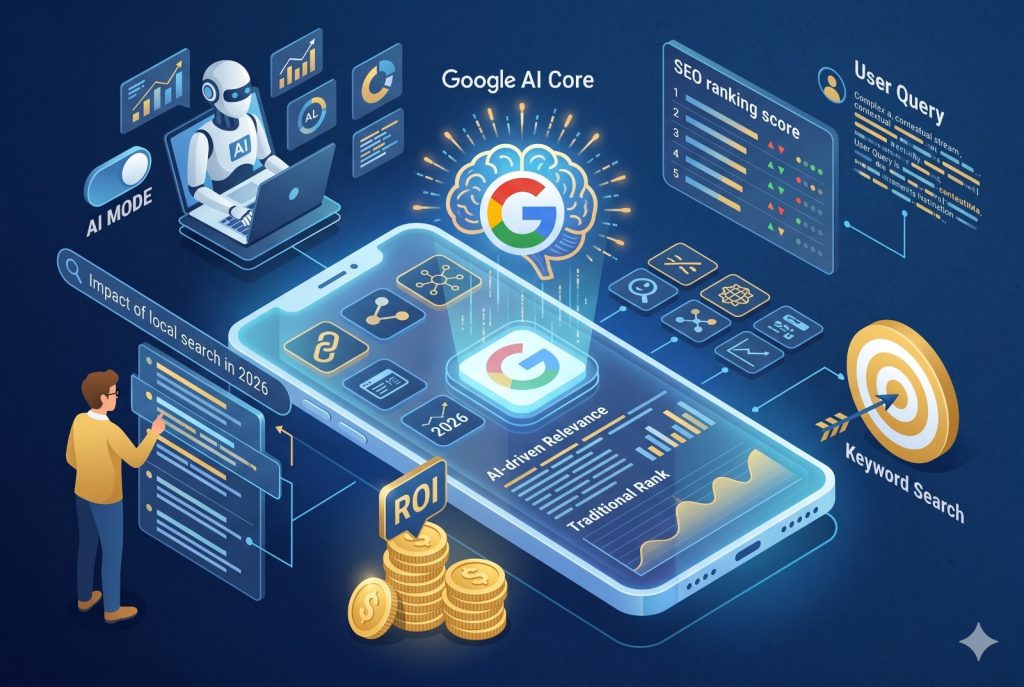
Google’s AI Mode vs Traditional Search: What It Means for Your Website Rankings
It’s not just about being at the top of a list of links anymore. Google has added AI-powered search features over the past year that are changing the way people look for information online. People are getting more and more direct, short answers on the search page itself instead of having to click through many websites.
This change is important for businesses, marketers, and website owners. It changes how rankings work, how traffic is spread out, and how content needs to be made. You may already be seeing changes in performance if your strategy is still based only on traditional SEO.
It’s important to know the difference between Google’s AI Mode and the old way of searching if you want to stay competitive. This will help you understand what it means for your website in the future.
Understanding Traditional Search (Classic SERP)
A ranking system is used to create traditional search results, which are often called the SERP (Search Engine Results Page). When someone searches for something, Google shows them a list of web pages in order of how relevant and authoritative they are.
For a long time, SEO strategies have been aimed at making this ranking better. To get higher rankings, websites used keywords to improve their content, built backlinks to boost their authority, and improved their technical performance.
It was easy to understand: the higher your page ranked, the more people saw it and clicked on it. Position one got the most traffic, while lower positions saw a steady drop in engagement.
This system made it possible to predict and measure rankings. How high your website showed up in search results was a big part of what made you successful.
What is Google AI Mode?
Google’s AI Mode introduces a different approach. Instead of showing only links, it generates a direct response to the user’s query by combining information from multiple sources.
This response is designed to be:
- Immediate
- Context-aware
- Conversational
Users can also ask follow-up questions, turning search into an interactive experience rather than a one-time query.
The key difference here is that users often get what they need without clicking on any website. This changes the role of search results from being a destination to being a source of information for AI-generated answers.
How Rankings Behave Differently in AI Mode
One of the biggest misconceptions is that rankings still work the same way in AI-driven search. They do not.In traditional search, rankings are fixed and visible. A page is either first, second, or tenth. Traffic distribution is heavily influenced by these positions.
In AI Mode, there is no clear ranking hierarchy. Content is chosen instead, depending on its usefulness, relevance, and trustworthiness in addressing the question at hand. A single answer might draw from various sources, with their information being summarized or rephrased.
This leads to a couple of significant shifts. For one, a webpage doesn’t have to be the absolute best to be seen; it just needs to be good enough to be featured. Furthermore, even pages that rank highly could see fewer clicks if the AI-generated answer fully meets the user’s needs.In simple terms, ranking is no longer the only goal. Being useful is.
What Content Types Still Perform Well
The advent of AI filtering and summarization has resulted in unequal performance across content. Consequently, the nature and caliber of the content have become significantly more influential.
Content that offers explicit and concise answers is more frequently incorporated into AI-generated outputs. When a webpage directly addresses a specific query in a structured and easily understandable manner, it facilitates the extraction and presentation of information by AI systems.
Furthermore, the depth of the content is a crucial consideration. Websites that provide thorough coverage of a subject tend to be perceived as more authoritative. Rather than simply publishing individual articles, effective websites are constructing comprehensive content ecosystems centered on core topics
Furthermore, originality has become increasingly important. Content that merely reiterates widely available information offers minimal value to AI systems. Conversely, content that incorporates unique insights, practical examples, or expert viewpoints distinguishes itself.
Structure is equally important. Well-organized content with clear headings, logical flow, and readable formatting improves both user experience and machine understanding. This increases the chances of your content being selected.
On the other hand, thin content, keyword-heavy writing, and articles created purely for ranking purposes are gradually losing effectiveness. AI can easily replicate such content, making it less valuable in search results.
H2;How to Adapt Your SEO Strategy
Adapting to AI-driven search does not require abandoning traditional SEO, but it does require evolving beyond it.The first step is to focus on user intent. Instead of optimizing only for keywords, content should directly address the user’s question or need. This means providing clear answers early in the content rather than delaying them.
Content should also reflect how people search today. Queries are becoming more natural and conversational, so writing in a similar tone helps improve relevance. Building topical authority is essential. Rather than creating disconnected pieces of content, websites should aim to cover subjects in depth, linking related topics together to create a strong knowledge base.
Regular updates are also important. Search systems prefer content that is accurate and up to date. Revisiting older pages and improving them can significantly improve performance. Technical SEO continues to play a supporting role. Fast loading speeds, mobile-friendly design, and proper site structure ensure that content is accessible and indexable.
Overall, the goal is to create content that is not just optimized for search engines, but genuinely useful for users.
H2;Ready to Adapt Your SEO Strategy?
If your website is still relying only on traditional rankings, now is the time to evolve. At Techco, we help businesses adapt to modern search by combining SEO fundamentals with AI-focused strategies. From building authority-driven content to optimizing for AI visibility, the focus is on sustainable growth and long-term results.
Get in touch with Techco to ensure your brand stays visible in the future of search.
Conclusion
The shift from conventional search methods to AI-powered outcomes is reshaping how individuals and businesses gain visibility on the internet. While rankings remain significant, they’re no longer the sole measure of achievement.
Websites fixated solely on their ranking positions risk becoming less relevant, less clear, and less authoritative in a landscape that prioritizes those qualities. Conversely, those who evolve by producing high-caliber, well-structured, and thought-provoking content can attract greater attention, even within AI-generated responses.