
How to Build a Marketing Funnel in 2026 That Actually Converts
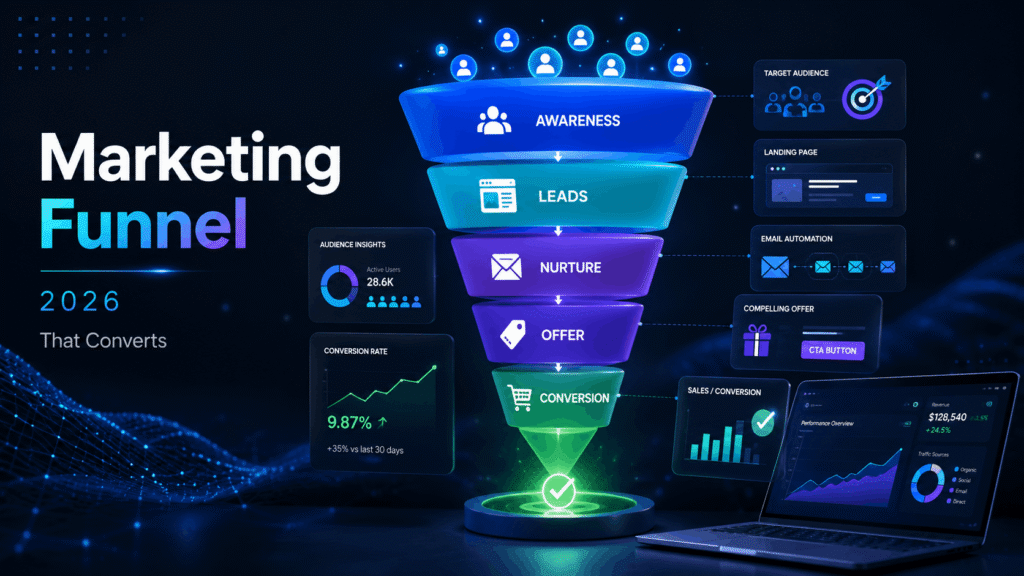
How to Build a Marketing Funnel in 2026 That Actually Converts
Here’s the truth. Most marketing funnels leak money. Not because the traffic is bad. But because the funnel behind the ads is broken.
You bring people in. They visit. They vanish. Sound familiar?
The brands actually growing in 2026 aren’t just running ads. They’ve built full, tight, well-oiled marketing funnels that turn strangers into customers, and customers into repeat buyers. And no, it’s not rocket science.
This guide breaks down exactly how to build a marketing funnel that actually converts in 2026, step by step.
What Is a Marketing Funnel?
Think of a marketing funnel like a real funnel in your kitchen. Wide at the top. Narrow at the bottom.
At the top, you pour in a lot of stuff (people who don’t know your brand yet). At the bottom, only the ones who really wanted it come out (paying customers).
A funnel guides people through 4 clear stages:
- Awareness. They discover you.
- Interest. They learn more about you.
- Decision. They compare and consider buying.
- Action. They buy from you (and hopefully come back).
Simple concept. Massive impact when done right.
The 4 Stages of a Modern Marketing Funnel
Here’s how each stage actually works in 2026.
1. Awareness (Top of Funnel)
This is where strangers first hear about your brand. Usually through:
- Social media reels
- SEO blogs (like this one)
- Paid ads on Meta, Google, or YouTube
- Influencer content
- Viral videos or trending posts
Goal at this stage? Just get noticed. That’s it. Don’t try to sell yet.
2. Interest (Middle of Funnel)
Now they know you exist. Time to build trust.
Content that works here:
- Email newsletters
- Educational blogs and guides
- YouTube tutorials
- Free downloads and lead magnets
- Case studies
At this stage, teach. Don’t push. That’s what separates smart brands from spammy ones.
3. Decision (Bottom of Funnel)
This is where they’re actively thinking of buying. Your job? Make it easy.
Use:
- Comparison pages
- Testimonials and reviews
- Product demos or free trials
- Discount codes
- Retargeting ads
If your website, prices, and offers are clear here, sales happen. If not, they bounce and buy from a competitor.
4. Action (The Purchase)
They’re ready. Don’t ruin it with a bad checkout experience.
Fix these fast:
- Slow-loading product pages
- Confusing checkout steps
- Hidden charges at the last minute
- Weak return or refund policies
Smooth checkout equals more sales. Every single time.
Step-by-Step: How to Actually Build Your Funnel
Alright. Enough theory. Here’s the practical build order.
Step 1: Pick one clear goal: Sales? Signups? Bookings? Focus on one thing per funnel.
Step 2: Choose your traffic source: Meta Ads, SEO, Google Ads, influencers. Pick 1 or 2 to start.
Step 3: Build your landing page: Not your homepage. A dedicated landing page with 1 offer, 1 message, 1 CTA.
Step 4: Create a lead magnet: Free guide, discount, template, mini-course. Something valuable to collect emails.
Step 5: Set up email automation: Welcome sequence, nurture emails, offer emails. Tools like Mailchimp, Klaviyo, or HubSpot handle this easily.
Step 6: Add retargeting: Not everyone buys the first time. Retarget them on Meta and Google.
Step 7: Track and improve: Use Google Analytics 4 and Hotjar to see where people drop off. Fix those spots.
That’s the full loop. Do it once, and you can scale it up as much as you want.
Quick Comparison: Old Funnel vs 2026 Funnel
Here’s how things have shifted:
| Feature | Old Funnel | 2026 Funnel |
| Traffic Source | Cold ads only | Ads + SEO + AI search + influencers |
| Landing Pages | Generic homepages | Dedicated, personalized pages |
| Email Strategy | Same for everyone | Segmented and automated |
| Retargeting | Barely used | Core part of the funnel |
| Analytics | Basic tracking | AI-driven insights |
| Focus | One-time sales | Retention and lifetime value |
Same funnel logic. Way smarter execution.
Best Tools to Build Your Funnel in 2026
You don’t need 50 tools. Just the right ones. Here’s a solid stack:
- Landing pages: Unbounce, Leadpages, or Framer
- Email marketing: Mailchimp, Klaviyo, or HubSpot
- CRM: HubSpot, Zoho, or Salesforce
- Ads: Meta Ads Manager, Google Ads
- Analytics: Google Analytics 4, Hotjar, Microsoft Clarity
- AI Tools: ChatGPT for copy, Jasper for email flows
Pick tools that talk to each other. That’s how funnels stay clean.
Common Marketing Funnel Mistakes to Avoid
Don’t waste your budget on these:
- Sending cold traffic straight to a sales page
- No lead magnet or email capture
- Forgetting to retarget non-buyers
- Using homepages as landing pages
- No email follow-ups after signup
- Not tracking where people drop off
Any one of these can quietly kill your funnel. Fix them and watch your conversion rate climb.
How TechCo Agency Can Help You
Building a marketing funnel isn’t just about tools. It’s about strategy. A strategy that connects ads, landing pages, emails, retargeting, and analytics into one smooth system.
That’s exactly what TechCo Agency does.
We’re a 360 digital marketing agency that builds full marketing funnels for brands that actually want results. From the first ad to the final purchase (and everything in between), our team designs, builds, and optimizes it all.
Here’s what we help with:
- Funnel Strategy. Custom funnels built around your business goals.
- Landing Page Design. High-converting pages that turn visitors into leads.
- Paid Ads Management. Meta, Google, and YouTube ads that pull real ROI.
- Email and Automation. Sequences that convert leads into customers.
- Analytics and Optimization. Track, tweak, and scale what actually works.
If your funnel is leaking, TechCo Agency will help you fix it fast.
Final Thoughts
A good marketing funnel isn’t a fancy trick. It’s just a smart, well-connected system.
Get the right people to notice you. Build their trust with useful content. Make it easy to buy. Then keep them coming back. That’s literally the whole game.
In 2026, brands without a proper funnel are basically burning money on ads. But the ones that do have one? They grow steadily, predictably, and profitably.
So whether you’re starting from scratch or fixing what’s already there, use this guide to build a funnel that actually converts.