
SEO vs AEO vs GEO: Understanding the New Search Ecosystem of 2026
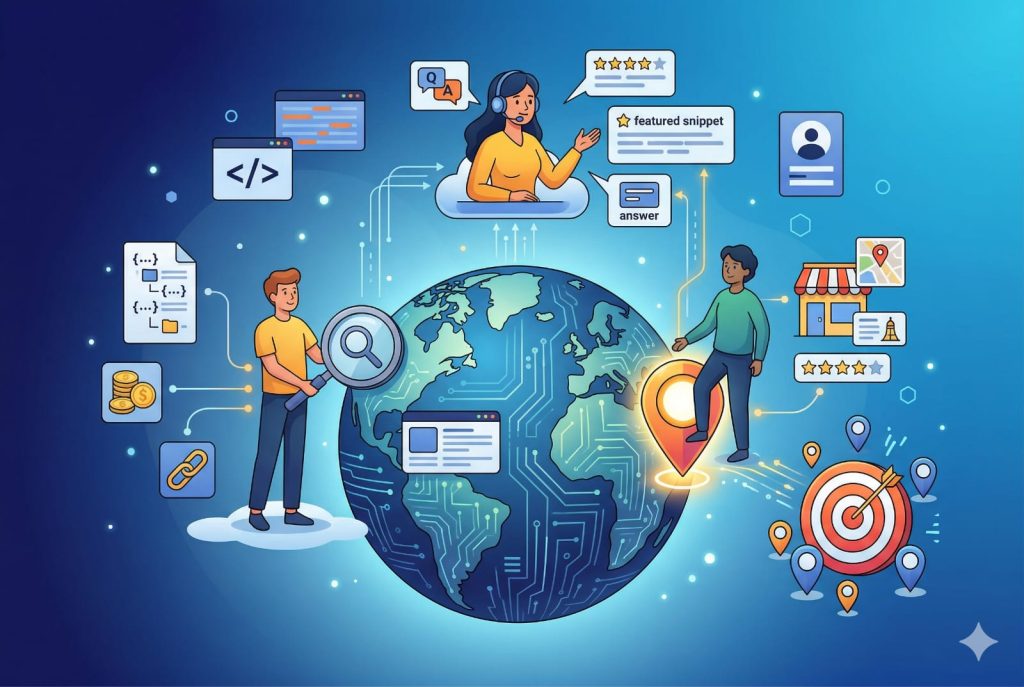
SEO vs AEO vs GEO: Understanding the New Search Ecosystem of 2026
If you’re still thinking search is just about “ranking on Google,” it’s time to adjust your perspective. The search world has changed dramatically.
By 2026, search isn’t just about typing in keywords and getting a list of links. It’s become a sophisticated, AI-powered environment. Information is presented in a smarter, more conversational way, tailored to each individual. People now want fast, precise answers that are relevant to their specific situation, often without having to sift through different websites.
This shift is largely thanks to the quick progress in artificial intelligence and natural language processing.
Modern search experiences are increasingly shaped by systems that can interpret intent, understand context, and generate precise answers in real time. As a result, the role of search engines has expanded from indexing information to actively synthesizing and presenting it.
User behavior has evolved in parallel. Instead of entering fragmented keywords, individuals now pose complete questions, engage with voice assistants, and rely on AI-powered platforms for recommendations and insights. This shift has reduced dependence on traditional search result pages and increased reliance on direct, AI-generated responses.
Consequently, digital visibility is no longer defined solely by rankings. It now depends on how effectively content can be understood, extracted, and utilized by intelligent systems. Being present is no longer sufficient; content must be structured, authoritative, and aligned with how modern search technologies operate.In this evolving environment, three concepts have emerged as critical pillars of digital strategy: SEO, AEO, and GEO.
The Shift: From Search Engines to Answer Engines
Previously, users would search using keywords, browse through multiple links, and choose a website to visit. Today, the process is far more streamlined. Users ask direct questions, and AI systems often provide immediate answers without requiring users to click on any link.
This shift has fundamentally changed digital visibility. It is no longer just about appearing in search results-it is about becoming the source from which answers are generated.
What is SEO (Search Engine Optimization)
SEO is still the most important part of having an online presence. The key to moving up in the search engine rankings is to make small changes to your website. This means choosing the right keywords, getting good backlinks, making sure your site loads quickly and works well on phones, and putting out content that is useful.Consider this: someone types “best cafes in Delhi” into a search engine. SEO is what gets your site on that coveted first page. But there’s a new challenge. Even if your site is at the top, people might not click on it if their question is already answered right there in the search results, or by AI-generated responses.
What is AEO (Answer Engine Optimization)
AEO is based on the same ideas as SEO, but instead of ranking, it focuses on answering.It is the practice of organising your content so that search engines and AI systems can pull it out and show it as a direct answer. This is especially important for answer boxes that use AI, voice search, and featured snippets.
For instance, when someone asks, “What is the best time to post on Instagram?” the system may display a concise answer immediately. If that answer is taken from your content, you have successfully implemented AEO.
For AEO, content needs to be both clear and well-organized. Directly answer the questions posed, keep explanations short, and present information in a way that’s easily understood by both people and search engines. Incorporating FAQ sections and structured data can significantly improve your chances of being chosen as an answer provider.
What is GEO (Generative Engine Optimization)
GEO is the next step in the development of search.When AI systems make responses, this focuses on making sure that your brand and content are recognised and included. GEO is different from SEO and AEO because it focuses on influence-being part of the AI’s decision-making process.
For instance, if a user asks an AI tool for suggestions, the tool might suggest certain brands or services. If your brand is mentioned in that response, it means that GEO is doing well.To get there, you need more than just well-optimized content. It means establishing authority, trustworthiness, and a steady presence on a number of platforms. When AI systems come up with answers, they rely a lot on trust signals, understanding the context, and recognising brands.
Understanding the Difference in Approach
SEO, AEO, and GEO aren’t rivals; they’re different facets of the same digital landscape.
SEO’s primary goal is to make your content visible via search engines. It involves getting your website indexed, ranked, and ultimately found by people looking for specific information.
AEO builds on this foundation, concentrating on how that information is displayed.
Instead of simply attracting clicks, it ensures that your content directly answers user queries in a structured and concise manner.
GEO goes beyond both by emphasizing authority and trust. It ensures that when AI systems generate responses, your brand is recognized as a reliable and relevant source worth mentioning.
In essence, SEO helps users find you, AEO helps you answer them, and GEO helps you become a trusted reference.
Why This Matters in 2026
User behavior has shifted significantly. AI-generated responses are increasingly trusted, and users expect faster, more accurate information. As a result, traditional click-based strategies are becoming less effective on their own. Businesses that rely only on SEO risk losing visibility in an environment where answers are delivered instantly and often without requiring user interaction.
A more effective approach combines all three strategies. SEO ensures your content exists within the searchable ecosystem. AEO ensures your content is usable as a direct answer. GEO ensures your brand remains visible within AI-driven interactions.
Practical Strategy for Businesses
Businesses need a multi-faceted strategy to thrive in today’s search landscape.
Start with a solid SEO foundation. This means ensuring your technical setup is sound and that you’re producing top-notch, pertinent content. Without this groundwork, your content might as well not exist.
Then, use AEO methods. Make your content based on the questions that real people are asking. Give clear, short, and direct answers that search engines and AI can easily understand and index.
Finally, build a strong brand presence to grow into GEO. Publish content that is reliable, make sure that your brand is linked to trust and expertise, and keep things consistent across all platforms. This makes it more likely that AI-generated answers will mention you.
The Future of Search
Search is no longer just about rankings. It is becoming more and more defined by selection, or which sources AI systems decide to trust and show.As AI continues to change how people find information, being seen as a reliable source will become more important than just being at the top of search results.Companies that quickly adapt to this change will have a big edge over their competitors.
Final Thoughts
The digital landscape has evolved from ranking content to selecting authoritative sources.Success now depends on the ability to be discoverable, provide immediate value, and earn trust within AI-driven systems.Businesses that align with this new ecosystem will not only remain competitive but will be better positioned to lead in the future of search.